Gross Domestic Product (GDP) is a monetary measure of all the good and service produced in a country in a specified time – It has become the single most important measure of success of our economy and we have become obsessed with continual growth. But it doesn’t take into account many of the issues that actually affect our lives, such as health and well-being, income, gender equality or the state of the environment.
It perhaps can be said to have served us well over the last century when providing employment and manufacturing industry has been seen as a way to grow our standard of living and thus wealth which means more production and more consumption, so the cycle continues. Governments have grown accustomed to its benefits too, in being accustomed to paying next year’s costs based on increases in GDP and therefore increased tax revenue to balance the books. But is it sustainable today?
It has worked well over the last 100 years or so. Certainly, I enjoy a higher standard of living than my parents. However, my children might struggle to maintain this standard of living, and my grandchildren will see a decline if we continue along this path.
Even Simon Kuznets, the economist who presented the original formulation of GDP, said in 1934 that: “The welfare of a nation can scarcely be inferred from a measurement of national income.”
The economic models that support it are fairly simplistic and looking at any growth curve shows it cannot go on for ever with finite resources- This coupled with cost-benefit analysis results in a very short-term view because future benefits are -discounted- (this means they are perceived to have much less value if the benefit is attained in future years)
In the 1970’s there was a think tank that produced a report called ‘Limits to Growth’. Basically the report suggested with the help of a world model that on a finite planet we would eventually run out of natural resources, be limited by the amount of food we could produce and pollution would start to impact progress. Furthemore unless we changed things it was likely we would reach these limits in the next 100years.
Needless to say the report received much criticism and ridicule for it simplistic modelling even though it went on to sell 30 million copies in 30 languages.
Over 50 years on and little progress in addressing the issues its basic prognosis is beginning to emerge. Whilst economic growth has raised our standard of living it has turned us (in Lilly Allen’s words) into ‘weapons of massive consumption’. This means that waste and pollution as well as natural resources have become critical issues.
Of course climate change has now come to be accepted (even though it was openly known in the 1950’s what rising CO2 levels would do). Economists themselves have begun to question the models that are used as the foundation of economic learning especially since the 2008 crash and some new models have started to emerge that give us some alternative goals.
President Kennedy made a famous speech back in 1968 stating ‘GDP measures neither our wit nor our courage, neither our wisdom nor our learning, neither our compassion nor our devotion to our country’, ‘It measures everything in short, except that which makes life worthwhile.’
Increasingly these new models take a much longer-term view of benefits and well being.
Doughnut economics developed by Kate Raworth is one of these. Basically, it sets limits to our growth based on a safe social foundation for us thrive but stay within nine planetary limits that would otherwise destroy our environment eg pollution, air quality, water supply, climate etc. As at 2023 it has been assessed we have breached 6 of these.
(Stockholm Resilience Centre, Stockholm University. Based on Richardson et al. 2023)
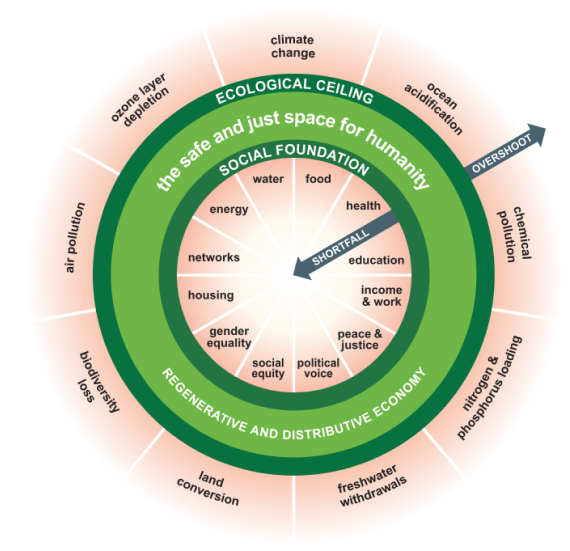
Donut model
It is gaining traction now with local governments and city councils- for example Amsterdam adopted the model in 2020 in order to balance local wellbeing with global economic boundaries.
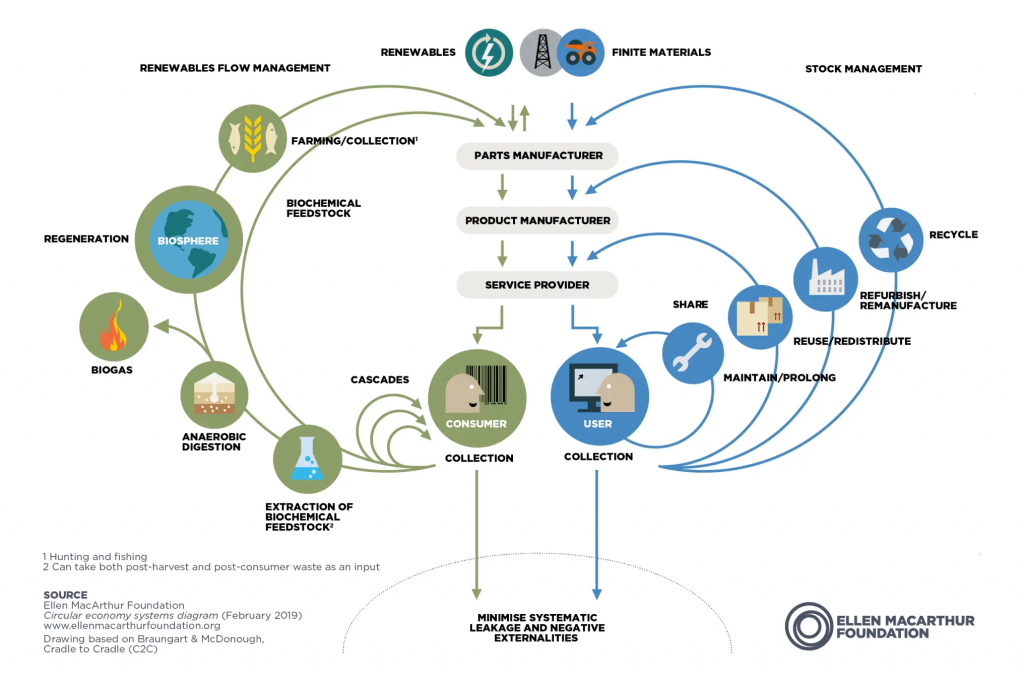
Closely aligned to this is the circular economy, which aims to minimize waste and maximize resource efficiency. It is a regenerative system that seeks to keep resources in use for as long as possible, reducing the extraction of finite resources and minimizing environmental impact. This model has been proposed by the Ellen MacArthur Foundation and it’s been gaining a lot of attention in recent years. The concept is to move away from the traditional linear “take-make-dispose” model of production and consumption and create a more sustainable economy. In a circular economy, products are designed to be reused or recycled, and waste is seen as a valuable resource rather than something to be thrown away.
Bhutan currently has a Gross national happiness index GNH adopted in 2008. It looks at nine different factors including psychological well-being, health, time use, education, cultural diversity and resilience, good governance, community vitality, ecological diversity and resilience, and living standards.
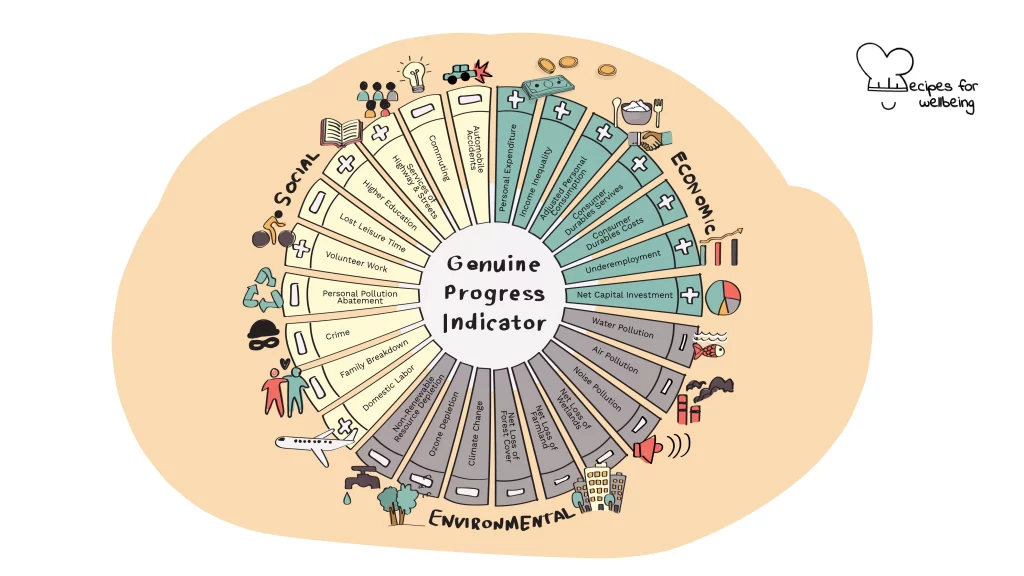
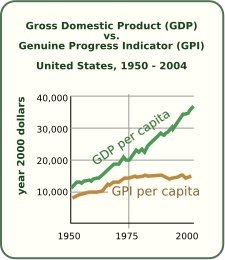
Genuine Progress Indicator (GPI) is a metric that has been proposed to replace, or supplement GDP. The GPI is designed to take fuller account of the well-being of a nation, only a part of which pertains to the size of the nation’s economy, by incorporating environmental and social factors which are not measured by GDP. It is much harder to achieve as the comparison chart illustrates.
New Zealand’s chief economic advisor at the Treasury recently said, “We want to look beyond GDP to understand progress, but we don’t have a singular measure of wellbeing — so we need to look across a range of indicators and evidence to understand progress in this broader sense,” Among their findings published on Nov. 24, the report highlighted the wide and growing gap between the well-being of older citizens and that of younger citizens, with older citizens faring better on a range of metrics.
The core of the concept of the “Economy for the Common Good” (ECG) is to redefine the goals and standards of economic activity to prioritise the well-being of people and the planet over pure financial gain. The Economy for the Common Good proposes a radical shift in economic thinking and behaviour towards a more ethical and sustainable framework. Based in Germany there is also a growing network of practitioners in Italy Spain.
Successive Uk governments follow the growth model as the holy grail – often backtracking on commitments to improve health and protect the environment on the basis of today’s cost but are not held to account for the ultimate cost of NOT reducing co2 and protecting the environment for future generations which is an appalling act of neglect.
There is growing concern that economic growth is unsustainable and at the same time is beginning to reduce our quality of life and wellbeing. Perhaps we now have outgrown growth.
Further reading
Doughnut economics Kate Raworth
The Good Ancestor Roman Krznaric
The growth consensus unravels J Rowe
How to Build a Circular Economy | Ellen MacArthur Foundation
Leave a Reply